Posts

Showing posts with the label Justice

The Ethics of Climate Change

John Broome, Professor of Moral Philosophy at the University of Oxford and previously a professor of economics at the University of Bristol, has a very interesting analysis of the ethics of climate change in the Scientific American . the ethical issue he focuses on this this: future generations will benefit the most from the current generation's efforts to stop climate change, but the evidence is that future generations will be richer. As any economist will tell you, in doing a cost-benefit analysis, a critical factor is the selection of the discount rate. As I previously noted , the Stern Report did an economic analysis that set the discount rate very low. Broome explains why this makes sense from a moral point of view. It is a long article. Here are some excerpts: Climate change raises a number of ethical questions. How should we—all of us living today—evaluate the well-being of future generations, given that they are likely to have more material goods than we do? Many people, s...
Dorothy Day

May 1 will be the 7th anniversary of the Catholic Worker's movement, and Marquette University Press has published "The Duty of Delight," a collection of Day's diaries, as well as a 2006 documentary, "Don't Call Me a Saint," is out on DVD. The Dallas Morning News Religion blog has further details: Dorothy Day, the founder of the Catholic Worker Movement , was a pacifist, a champion of the poor, a Communist (for a time), a writer, and a hell-raiser who took part in countless demonstrations in support of workers, women, the poor and the disenfranchised. She spoke her mind. Before embracing Catholicism, she led what was once colorfully called a "bohemian" lifestyle. She had affairs, a common-law marriage, and a back-alley abortion, about which she wrote in a novel, "The Eleventh Virgin." She died in 1980 at age 83. On May 1, the Catholic Worker Movement celebrates its 75th anniversary. Today, there are more than 185 Catholic Worker houses...

Bishop Kirk Smith on Sheriff Arpaio's Round-ups

The Diocese of Arizona has a Spanish language congregation, San Pablo, that has been hit especially hard by Sheriff Arpaio's anti-immigrant round-ups. For those outside of Arizona, our local Sheriff will put huge resources in predominately Hispanic areas of the county. They will look for small infractions--such as broken headlights and the like, with the hope of catching undocumented immigrants. (Meanwhile, thousands of felony warrants go unserved for alleged lack of resources). Bishop Kirk Smith used his weekly column to point out how a Good Friday round-up hurt San Pablo worshippers: Thursday night I spoke to a group of about 1,500 members of the East Valley Interfaith, an ecumenical group that works with political leaders to further such causes as public safely, education, health care, and immigration reform. It was apparent from that meeting that Arizona has a major church/state crisis on its hands as it reacts to the tactics used by the County Sheriff in his crusade to catch u...

More on the Ethics of Climate Change

Image
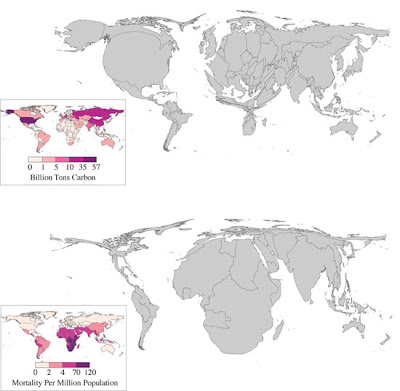
I have repeatedly said that the most serious moral issue involved in climate change is that the real burdens of the effects of climate change fall on the poorest of the poor--who did not benefit from the wealth created by the emissions of greenhouse gases in the past. There is a new study that reinforces my point: The public health costs of global climate change are likely to be the greatest in those parts of the world that have contributed least to the problem, posing a significant ethical dilemma for the developed world, according to a new study. In a paper to be published the week of Nov. 12, 2007, in the journal EcoHealth, a team of researchers led by environmental public health authority Jonathan Patz of the University of Wisconsin-Madison reports that the health burden of climate change will rest disproportionately on the world's poor. "Our high consumption of energy is putting a huge disease burden on places that are quite remote from us," explains Patz, a profes...

This May Explain A Lot about Anti-Americanism

The Episcopal Cafe has a very disturbing essay by Joel Merchant about his experience with how foreigners are sometimes treated in the US under the guise of national security. The essay is causing a great of dicussion on the web (and it caused the Episcopal Cafe traffic to increase eightfold). I thought you would benefit from reading highlights from the post: Countries, like people, make friends with others one at a time. This is a story of one failure. In fairness to an unknown visitor to our country, imagine yourself in his place. The scene is on a recent Amtrak trip between New York City and Boston. The conductor collects tickets, requests identification, folds destination stubs into seatbacks, moves on to other cars. An older man across the aisle, traveling alone, shows his passport. It is clear from their conversation he doesn’t know English. After decades as a frequent traveler, I have thousands of pictures -- scenery, buildings, people, architecture, from around the world. Toda...

Today's Hidden Slavery

Bob Herbert of the New York Times has a must-read column this week on the often forgotten issue of modern slavery--in the United States. As I have said before, this is a moral issue that should be at the forefront of any values agenda. Sadly, it is not: The woman testifying in federal court in Lower Manhattan could hardly have seemed more insignificant. She was an immigrant from South Korea and a prostitute, who spoke little or no English. She worked, she said, in brothels in New York, Philadelphia, Georgia, Connecticut, Rhode Island and Washington, D.C. She did not offer a portrait of the good life. Speaking through an interpreter, she told about the time in D.C. when a guy came in who looked “like a mental patient, a psycho.” Weirded out, she wanted nothing to do with him. But she said the woman who ran the brothel assured her everything would be fine. It was fine if you consider wrestling with Hannibal Lecter fine. The john clawed at this woman, gouging her flesh, peeling the ski...

Paul Klugman on Inequality

Image
Paul Klugman of the New York Times has just started a blog , and one of his first posts--indeed, the post introduces his blog--is on the issue of inequlaity in the United States. It is well worth reading. He argues in that post that inequality in the U.S. is the result of political decisions--not inpersonal market forces. Here are some highlights: In fact, let me start this blog off with a chart that’s central to how I think about the big picture, the underlying story of what’s really going on in this country. The chart shows the share of the richest 10 percent of the American population in total income – an indicator that closely tracks many other measures of economic inequality – over the past 90 years, as estimated by the economists Thomas Piketty and Emmanuel Saez. I’ve added labels indicating four key periods. These are: The Long Gilded Age : Historians generally say that the Gilded Age gave way to the Progressive Era around 1900. In many important ways, though, the Gilded Age...

Pedophile Tourists

There are some issues that have great moral clarity--black and white, good and evil--and yet get ignored by nearly everyone. Worldwide child prostitution is such an issue. It is wrong--no ifs or qualifications, and yet every year tourists from the United States travel abroad for the very purpose of having sex with a child. Nicholas Kristof of the New York Times has done a great job of trying to focus attention on this issue. today, Michael Gerson has a great column about how progress is finally being made in combating this sex tourism: One sexual predator, when interviewed by the FBI , described his experience with foreign child prostitutes this way: "It's like being a star. They want to try my food. They want to see what clothes I wear. They want to watch my television." Such "stars" are the global consumers of innocence, exercising a particularly brutal form of power over the poorest, most vulnerable children on Earth. About 25 percent of sex tourists targeti...

Evangelicals and the Social Gospel

Image
David Kuo has a very interesting post today about how evangelicals today seem to be moving toward embracing at least some aspects of the social gospel--without using that label: Over at SoMA , Paul O'Donnell revisits Social Gospel creator Walter Rauschenbusch on the 100th anniversary of his famed book, Christianity and the Social Crisis. The book has been re-issued with new essays by Jim Wallis, Stephen Carter, and others. Rauschenbusch's book was one of the most influential religious books of the 20th Century. It simultaneously fed and nurtured private and public efforts to care for the poor and caused more conservative Christians to split off into fundamentalism because they felt Rauschenbusch and other Social Gospel advocates were putting their emphasis on the wrong world and on the wrong things. Specifically, that Christian focus should be on the redeeming work of Jesus for sins and not on social works. [Note - this is a grand oversimplification but I didn't want th...

Children's Healthcare

One of the few positive public policy developments in recent years has been the expansion of coverage of children through the State Children’s Health Insurance Program (Schip). Simply put, Schip expands coverage of children (and pregnant women) in Medicaid systems. It is now time to reauthorize Scip, and there are two competing proposals--the bipartisan Senate version has a modest increase in coverage funded by an increase to tobacco taxes, and the Senate version has a much larger expansion, funded by a cut in insurance company subsidies under the Medicare program. The Bush Administration is threatening to veto both versions. Why? Paul Krugman of the New York Times thinks that the Bush Administration opposes expansion because it works too well. George Bush, who opposed this program when he was Governor, is fearful that success will put more pressure to further expand government health programs: When a child is enrolled in the State Children’s Health Insurance Program (Schip), the posit...

Infant Mortality Increasing in the South

The New York Times has a very important article about the unexpected increase in infant mortality (largely among African Americans) in the South. Given that there was a steady decline in recent decades--and that the U.S. has among the worst rates of infant mortality in the developed world--this is very bad news indeed. Here are some highlights: For decades, Mississippi and neighboring states with large black populations and expanses of enduring poverty made steady progress in reducing infant death. But, in what health experts call an ominous portent, progress has stalled and in recent years the death rate has risen in Mississippi and several other states. The setbacks have raised questions about the impact of cuts in welfare and Medicaid and of poor access to doctors, and, many doctors say, the growing epidemics of obesity , diabetes and hypertension among potential mothers, some of whom tip the scales here at 300 to 400 pounds. “I don’t think the rise is a fluke, and it’s a distu...

More on Modern Day Slavery

One of my favorite liberal columnists is Nicholas Kristoff of the New York Times . We both grew up in Oregon at about the same time, but I think that the reason I most enjoy Kristoff is that he uses the powerful pulpit of the New York Times op-ed pages to focus on issues of great moral importance that otherwise get largely ignored by Americans Today's column is no exception As he has done before, Kristoff has written a powerful and moving column about "human trafficking"--modern day slavery for both sex and labor. As I have written before, it is an outrage that there are millions of people (mostly young girls) sold into slavery, and yet we turn a blind eye. Here are some highlights from today's column : Anyone who thinks that the word “slavery” is hyperbole when used to describe human trafficking today should meet Meena Khatun. She not only endured the unbearable, but has also shown that a slave trader’s greed sometimes is no match for a mother’s love. Human traffic...

The Church and Modern Day Slavery

In a previous post , I discussed the importance of faith in the efforts to eliminate the slave trade in the English Empire--an effort recently popularized by the movie Amazing Grace . Sadly, human trafficking is still thriving, with tens of millions of people enslaved worldwide for both labor and sex. And just as the faithful led the battle to end slavery in both the English Empire and the United States, NPR's Religion & Ethics Newsweekly is reporting that the faithful, led by the progressive Christian group Sojourners, are once again leading the way to end modern day human trafficking: "Two hundred years ago, Member of Parliament William Wilberforce presented to the House of Commons a petition with 390,000 signatures, the climax of a campaign that led to the abolition of the transatlantic slave trade. . . . "The British bicentennial has received wide recognition in the U.S. as well, and this year contemporary abolitionists hope to submit a petition to the Congress w...